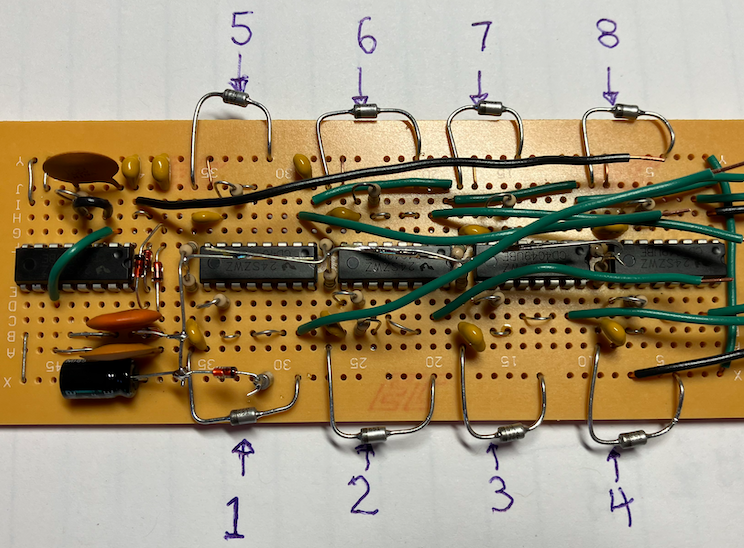
A photo of the test aparatus is shown below. The circuit board was custome designed and built by us and works in a similar way to the "Random Event Generator" in the PEAR study. There are 8 "channels" on this circuit board allowing 8 visitors to test at the same time.
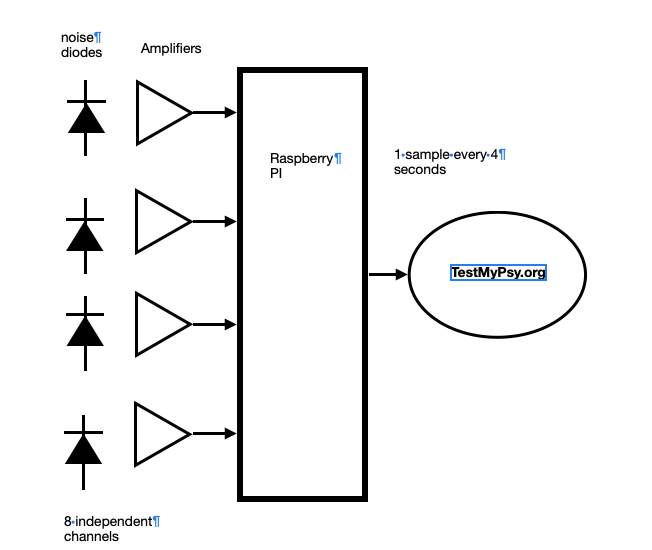
Each channel has a "noise generating avalanch diode", with its own amplifier. The amplifiers generate a digital signal which is fed into a Raspbery Pi (RPi) microcomputer. Think of the RPi as a camara. Once every 4 seconds the RPi samples (or takes a picture of) the signals from the amplifiers and sends the digital values (1 or 0) to the TestMyPsy.org website.
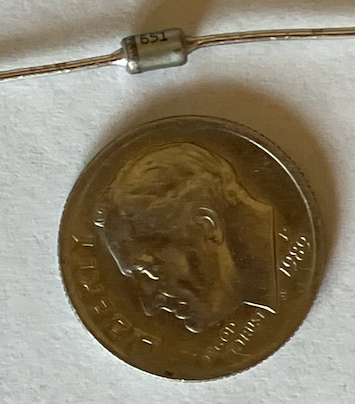
Each "noise diode", shown below, is about a quarter inch long with a glass body and 2 wires. Inside the glass body is a tiny piece of nearly pure silicon crystal. Inside of this crystal electrons continually "break free" from the crystal lattice, at random times produceing a tiny pulse of electrical current. (Physicists call this thermal generation). If an electron breaks free when the RPi computer is "snapping a picture" a digital "1" (or heads) is recorded. If an electron does not break free when the RPi "snaps an image" a digital "0" (or tails) is recorded. The choice of "1" or "0" is truly random, follows no pattern, and cannot be predicted in advance. Each diode therefore works like an "atomic level" coin toss, constantly flipping heads and tails.
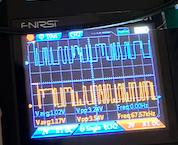
Measured waveforms from 2 channels are shown below.
We constantly store the digital signals on the testmypsy website and monitor them to make sure the test aparatus is working in a "statistically correct" way.